Overcoming Hidden Work in Revenue Operations Integrations
Connected systems can still create significant manual work. A RevOps lens shows where that work accumulates and why it matters.
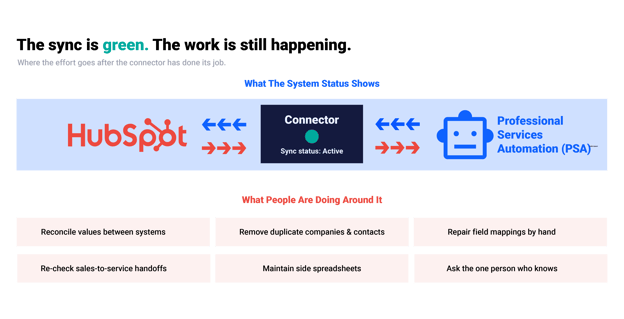
HubSpot is connected to the Professional Services Automation (PSA) platform. The sync is active, records are moving, and on paper the integration is working.
Then a sales leader asks for the current customer count. One person checks HubSpot, another checks the PSA, and a third opens the spreadsheet used to reconcile the two.
The gap between "the systems are connected" and "the business trusts the result" is where a significant share of RevOps work sits.
The connector is not always the issue. In the 2026 Integrates.io Technology Integration Survey, respondents identified data quality, limited field mapping, one-way or delayed sync, source-of-truth confusion, and unclear system ownership as common integration pain points. These are not purely technical problems. They are data, process, governance, and architecture problems.
Source: Integrates.io Technology Integration Survey for Autotask and ConnectWise, 2026. Survey of 107 IT professionals and decision-makers.
The Integration Can Work While the Revenue Process Still Struggles
A connector can move a value exactly as configured and still produce a poor business outcome. This happens when the systems carry rules the organization never fully defined.
For example, HubSpot may hold one customer status while the PSA holds another. A company record may exist twice because both systems can create it. A renewal date may sync, yet the team still corrects it by hand because the field means something different to sales and service. A dashboard may draw on both systems, yet someone reviews it before every leadership meeting because the team is not certain which source takes precedence.
Technically, the integration is active. Operationally, people are completing the work the integration was meant to do.
The Hidden Work Is a RevOps Signal
Revenue Operations (RevOps) is more than CRM administration or integration management. It is the operating layer that connects people, process, data, technology, and measurement across the customer lifecycle.
Manual work around an integration is useful diagnostic information. Common recurring tasks include:
- Reconciling values between HubSpot and the PSA before using them;
- Cleaning up duplicate companies or contacts after records are created in more than one place;
- Repairing field mappings or correcting values the sync does not handle;
- Checking handoffs from sales to service because the automated process is not trusted;
- Maintaining side spreadsheets for reporting, renewals, customer status, or recurring revenue;
- Relying on one experienced team member to explain which system, field, or report is "the right one."
Each task may take only a few minutes. Across a team and over time, they add up to an operating cost. More importantly, they show where the architecture still depends on human memory.
|
The work did not disappear. It moved. When people have to reconcile, translate, remember, or repair what the systems do not know, those people have become part of the integration. |
Why Hidden Integration Work Becomes a Growth Problem
It makes reporting harder to trust
If the data requires cleanup before it reaches a dashboard, reporting is already downstream of an unresolved problem. Better visualization does not fix unclear definitions, duplicate records, conflicting ownership, or missing lifecycle logic.
It makes handoffs inconsistent
Managed service providers (MSPs) rely on clean transitions from marketing to sales, sales to service, and service into renewal and expansion. When those transitions depend on someone checking a field or remembering an exception, the process becomes harder to repeat as volume increases.
It makes automation fragile
Automation is only as reliable as the rules underneath it. If lifecycle stages, account ownership, agreement status, or renewal logic are inconsistent, workflows can execute perfectly and still create the wrong result.
It makes the business dependent on tribal knowledge
The person who knows why a field maps a certain way or which report is safe to use becomes operational middleware. That arrangement may hold for a time, but it does not scale cleanly and it creates risk when roles change.
A Better Definition of "Integrated"
A more useful question than "Are HubSpot and the PSA connected?" is "How much human work is still required before the business can use what the integration produces?"
A healthier environment has clear system roles, defined ownership, intentional sync direction, consistent lifecycle rules, visible exceptions, and reporting that does not need to be explained before it can be trusted.
That is the RevOps layer around the connector. The connector moves information. Revenue architecture determines whether that information supports the way the business actually sells, delivers, renews, and grows.
Start by Following the Work
Before replacing technology, observe where your team spends time around the integration. Where are people comparing systems? What gets exported? Which values are corrected by hand? Which handoffs are checked manually? Which reports carry caveats?
These are not random annoyances. They indicate decisions the architecture has not yet made.
Once the hidden work is visible, the team can decide what belongs in the process, what should be automated, what needs clearer ownership, and what the integration should handle differently.