What a Healthy HubSpot & PSA Integration Actually Looks Like
A healthy integration does more than move data. It creates a clear operating model across sales, marketing, service, and revenue operations.
A healthy integration is quieter than most teams expect.
No one needs to confirm that the sync ran, ask in Slack which system is correct, or check a side spreadsheet before using a dashboard.
The systems perform their roles and the people perform theirs. The integration becomes infrastructure instead of a recurring conversation.
That does not happen because the connector is doing more. It happens because the revenue architecture around the connector is clearer.
A Healthy Integration Starts with an Operating Model
HubSpot and a Professional Services Automation (PSA) platform are different systems for a reason. HubSpot can support marketing, sales, pipeline, engagement, and customer communication. ConnectWise or Autotask can support service delivery, agreements, projects, time, and operational execution.
The goal is not to force every piece of information into one platform. The goal is to define how the systems work together across the customer lifecycle.
That requires decisions about system roles, ownership, sync direction, automation, exceptions, and reporting before the connector can do its best work.
Five Characteristics of a Healthy HubSpot + PSA Integration
1. Defined system roles
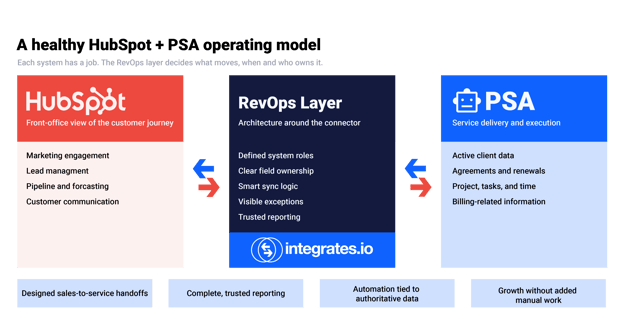
Each platform has a clear job. Teams know where information is created, where it is maintained, and where it is consumed. The systems complement each other instead of competing to own the same process.
2. Clear ownership
Important objects and fields have an authoritative owner. The business knows who or what can change a value, what happens when systems disagree, and when ownership changes as the customer moves from prospect to client to renewal.
3. Smart sync logic
The right information moves in the right direction for a defined business reason. Not everything has to sync both ways. Some data should originate in HubSpot and flow to the PSA. Some should originate in the PSA and appear in HubSpot. Some should stay where it belongs.
4. Visible exceptions
When something falls outside the normal process, it is surfaced instead of hidden. Teams can see failed handoffs, conflicting values, missing required data, or records that need human review. Exceptions are managed as exceptions, not absorbed into a permanent workaround.
5. Trusted reporting
Marketing, sales, service, and leadership can work from consistent definitions. The business can connect activity and pipeline in HubSpot with the service, agreement, renewal, and recurring revenue context that lives in the PSA.
|
The result: less manual work, better visibility, and a scalable HubSpot + PSA architecture. A healthy integration supports the customer lifecycle instead of asking teams to translate it by hand. |
What Changes When the Architecture Is Healthy
Sales-to-service becomes a designed handoff
A closed-won deal can trigger the right downstream actions with the context service needs. The handoff no longer depends on someone remembering to update another system or send a separate message.
Reporting becomes more complete
Leaders can connect marketing and sales activity to customer and service outcomes with fewer blind spots. That creates a stronger foundation for pipeline reporting, attribution, renewal visibility, and recurring revenue analysis.
Automation becomes easier to trust
Workflow triggers are tied to defined business events and authoritative data. Teams spend less time checking whether automation did the right thing because the rules underneath it are clearer.
Growth creates less operational drag
As the number of customers, agreements, projects, and renewals grows, the operating model does not require a matching increase in spreadsheets and manual reconciliation. The architecture can support more volume without asking people to become more sophisticated middleware.
This Is the RevOps Layer Around Integrates.io
The Integrates.io research found that technology integration alone does not create an effective revenue engine. The larger opportunity is to connect the people, processes, data, and technology that support the customer lifecycle from first engagement through sales, service delivery, renewal, and expansion.
Source: Integrates.io Technology Integration Survey for Autotask and ConnectWise, 2026, Chapter 9: The Connected Revenue Operations (RevOps) Model.
Integrates.io provides the managed, bi-directional integration layer between HubSpot and ConnectWise PSA or Autotask PSA. RevOps defines the architecture around that layer: what should move, when it should move, which system owns it, what automation should happen next, and how the business measures the result.
That combination matters because the connector is only one piece of the revenue system.
Healthy Integration Changes the Questions
When the environment is working well, the team stops asking which number is right, who owns the field, whether the handoff happened, or which spreadsheet has the latest version.
The conversation moves to the customer: Which opportunities are progressing? Which clients need attention? What is coming up for renewal? Where can we expand? What is creating revenue?
That is what a connected revenue operation should make easier to see.